A CIBIL score of 600 is the no-man’s-land of Indian credit: too low to get good personal loan rates from top banks, but not low enough that people truly panic and take action.
Most people at 600 drift for years — getting rejected by HDFC Bank, settling for high-rate NBFCs, paying 24–36% interest when they could be paying 11–14% with a 750+ score.
The difference between a 600 and a 750 CIBIL score on a ₹5 Lakh personal loan over 3 years? Approximately ₹80,000 to ₹1.2 Lakh in extra interest paid — just because of the score gap.
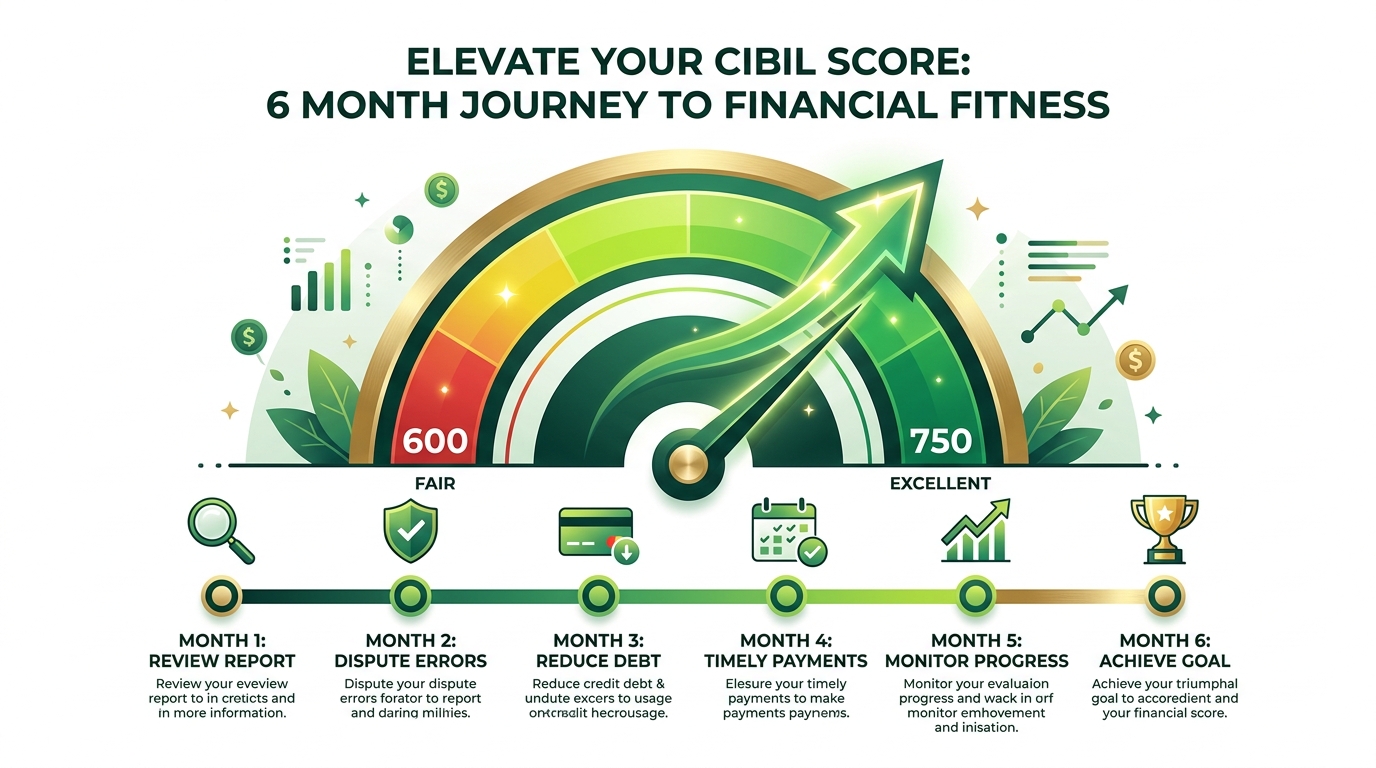
This guide gives you a precise, month-by-month 6-month plan to go from 600 to 750+. Every step is actionable, most are free, and all are legal. There are no credit repair agency shortcuts here — just the real actions that move the CIBIL needle.
Table of Contents
- Understanding Why Your Score is at 600
- The 5 Factors That Determine Your CIBIL Score
- Month 1: Audit, Clean, and Stop the Bleeding
- Month 2: Tackle Overdue Accounts and Fix Reporting Errors
- Month 3: Reduce Credit Utilization Aggressively
- Month 4: Build Positive Payment History
- Month 5: Manage New Credit Enquiries and Account Mix
- Month 6: Final Review, Score Check, and Loan Application Strategy
- What to Expect: Realistic Score Improvement Timeline
- Common Mistakes That Stall CIBIL Recovery
- FAQ: How to Increase CIBIL Score from 600 to 750
1. Understanding Why Your Score Is at 600
A score of 600 does not happen randomly. It is the result of specific, identifiable events in your credit history. The most common culprits:
| Common Reason for 600 Score | Typical Score Impact | Recovery Time |
|---|---|---|
| 1–3 missed EMI payments (30–90 DPD) | -50 to -100 points | 6–12 months after clearing |
| High credit card utilization (above 70%) | -40 to -80 points | 1–3 months after reducing |
| Multiple hard enquiries in a short period | -10 to -30 points | 3–6 months with no new enquiries |
| Settled loans (OTS — “Settled” status) | -75 to -150 points | 2–7 years (very slow) |
| Errors or ghost loans on CIBIL | -50 to -200 points | 30–45 days after dispute resolution |
| No credit history (new to credit) | Score: -1 or 600 (default) | 6–12 months of active credit use |
2. The 5 Factors That Determine Your CIBIL Score
Before improving your score, you must understand what drives it:
| Factor | Weight | What Hurts It Most |
|---|---|---|
| Payment History | 35% | Late payments, defaults, settled accounts |
| Credit Utilization | 30% | Using more than 30% of credit card limit |
| Credit History Length | 15% | Closing oldest credit card |
| Credit Mix | 10% | Only one type of credit (only cards or only loans) |
| New Credit Enquiries | 10% | Applying to 3+ lenders in 30 days |
3. Month 1: Audit, Clean, and Stop the Bleeding
Action 1: Pull Your Full CIBIL Report
Download your detailed CIBIL report at cibil.com (free once a year) or through apps like OneScore, Paytm, or Paisabazaar for free unlimited soft-checks. Do not just look at the score — read every account entry carefully.
Action 2: Identify and Dispute Errors Immediately
Check every account for:
- Loans you never took (ghost/identity theft loans)
- Closed loans still showing “Active”
- Correctly paid EMIs marked as “Overdue” or with DPD (Days Past Due)
- Wrong loan amounts or incorrect lender names
Raise disputes for every error at cibil.com → Dispute Centre → Ownership Dispute or Data Correction. Under RBI’s new weekly reporting from July 2026, corrections now reflect in 7–14 days after lender approval.
Action 3: Stop All New Loan Applications Immediately
Every loan application triggers a hard enquiry. Each hard enquiry drops your score by 5–10 points. For Month 1, your goal is to let existing damage age naturally while you fix what you can. Apply for absolutely nothing new in Month 1.
Action 4: Set Up Auto-Debit for ALL Active Loans and Credit Cards
Going forward, zero missed payments is non-negotiable. Set up NACH mandate (auto-debit) for every active EMI and at minimum, the minimum due on every credit card. Even one missed payment in Months 1–6 will reset your recovery timeline.
Expected Score Movement: 0–30 points (from error corrections if any).
4. Month 2: Tackle Overdue Accounts and Fix Reporting Errors
Action 1: Clear All Overdue (“Overdue” or DPD) Accounts
If your CIBIL report shows any account with DPD (Days Past Due) or “Overdue” status, clearing the full outstanding amount is the single highest-impact action you can take.
Even a single overdue of ₹500 on a credit card can hold your score 50–80 points below where it should be. Call the lender, pay the full overdue plus any penalty, and request a written confirmation that your account is now “Current.”
Action 2: Follow Up on Month 1 Disputes
Check if your dispute-raised errors have been resolved. With weekly CIBIL reporting now in place, if the lender confirmed the correction in Month 1, it should appear on your CIBIL report within 7–14 days. Confirm the correction is showing up accurately.
Action 3: Request “Settled” Status Update to “Closed” (Where Applicable)
If you have any loan showing as “Settled” (OTS — one-time settlement), contact the lender and negotiate to change it to “Closed” — sometimes possible if you pay any remaining balance and demonstrate good faith. “Closed” is far less damaging than “Settled” on CIBIL.
Expected Score Movement: 30–60 points (clearing overdues is the fastest score booster).
5. Month 3: Reduce Credit Utilization Aggressively
Credit utilization — how much of your credit card limit you are using — accounts for 30% of your CIBIL score. The sweet spot is under 30%. Above 50% is damaging; above 70% is severely damaging.
Action 1: Pay Down Credit Card Balances
In Month 3, aggressively pay down your credit card outstanding. If your total credit card limit is ₹1 Lakh and your balance is ₹65,000 (65% utilization), target reducing it to ₹25,000 or below (25% utilization).
Do not pay minimum due — pay as much as possible. The utilization improvement reflects in your score in the next weekly CIBIL reporting cycle — within 7–10 days of your bank reporting the reduced balance.
Action 2: Request a Credit Limit Increase
Contact your credit card issuer and request a credit limit enhancement. If approved (usually available after 6–12 months of on-time payments), your limit goes up — which mathematically reduces your utilization ratio even without paying down the balance.
Important: A credit limit increase request may trigger a soft or hard enquiry depending on the bank. Ask whether it is a soft pull before requesting.
Action 3: Spread Spending Across Cards
If you have two credit cards, using one at 80% utilization while the other is at 0% is worse than using both at 30–40% each. Spread spending to keep each card below 30%.
Expected Score Movement: 20–50 points from utilization reduction alone.
6. Month 4: Build Positive Payment History
By Month 4, your account is clean and your utilization is healthy. Now the goal is to build fresh, positive payment history as fast as possible.
Action 1: Get a Secured Credit Card
If you do not have a credit card (or your existing card has a low limit), apply for a secured credit card — a credit card backed by an FD of ₹10,000–₹20,000.
Banks like SBI, HDFC, and ICICI offer secured credit cards with 80–90% of the FD value as the credit limit. Use this card for small, regular purchases (groceries, utility bills) and pay the full balance every month — never carry a balance forward.
Each on-time payment is reported to CIBIL weekly (from July 2026), building your payment history rapidly.
Action 2: Use Your Existing Cards Responsibly
For any existing cards, make small purchases monthly (₹1,000–₹2,000) and pay them in full before the billing cycle. This establishes a consistent pattern of: credit usage → full repayment → no interest → positive history.
Expected Score Movement: 10–25 points from growing positive payment history.
7. Month 5: Manage Credit Enquiries and Diversify Credit Mix
Action 1: Continue Zero-Enquiry Discipline
Do NOT apply for any new loans, credit cards, or BNPL products in Month 5. You are in the final stretch of your 6-month plan. Even a single hard enquiry at this stage can cost you 5–10 points and may delay your goal.
Action 2: Consider a Small Credit-Builder Loan
If your credit profile currently has only credit cards (revolving credit) and no installment loans, adding a small, short-tenure personal loan improves your credit mix — contributing positively to 10% of your score.
Consider an NBFC personal loan of ₹25,000–₹50,000 for 6 months with easy approval based on your now-improved credit profile. Repay punctually. This adds an installment loan to your credit mix.
Expected Score Movement: 10–20 points.
8. Month 6: Final Review, Score Check, and Loan Application Strategy
Action 1: Pull a Fresh CIBIL Report
At the start of Month 6, pull a fresh detailed CIBIL report and check your score. If you followed the plan:
- Error corrections: +30–50 points (if errors existed)
- Overdue clearance: +40–70 points
- Utilization reduction to below 30%: +20–50 points
- 4 months of clean payment history: +20–35 points
- Total potential improvement: 110–205 points
Starting from 600, this puts you firmly in the 710–805 range — with 750 as a realistic midpoint target.
Action 2: Apply for Your Target Loan With Confidence
With a 750+ score, you now qualify for:
- Personal loans from HDFC, ICICI, Axis Bank at 10.5–14% p.a.
- Credit card upgrades and limit enhancements.
- Home loan pre-approval with competitive rates.
When applying, use an aggregator platform (Paisabazaar, BankBazaar) to check pre-approved offers before applying formally — soft checks show you which lenders are most likely to approve you without hitting your score with hard enquiries.
9. Realistic Score Improvement Timeline (Honest Expectations)
| Situation | Expected Score Gain in 6 Months | Likely Result |
|---|---|---|
| Had errors + overdue accounts + high utilization | +120 to +200 points | 720–800 (excellent) |
| Only high utilization + few late payments | +80 to +120 points | 680–720 (good) |
| Settled account on report | +40 to +80 points | 640–680 (below target, needs 12+ months) |
| No credit history (new to credit) | +80 to +150 points | 680–750 (on track) |
10. Common Mistakes That Stall CIBIL Recovery
- ❌ Paying only the “minimum due” on credit cards — minimum due does not reduce your utilization; only full payment does.
- ❌ Closing your oldest credit card — this shortens your credit history length and hurts your score.
- ❌ Applying to multiple lenders simultaneously — each hard enquiry drops your score. Apply one at a time.
- ❌ Ignoring a loan showing “Settled” — a settled status continues to drag your score for years. Negotiate “Closed” status immediately.
- ❌ Trusting “credit repair agents” — there is no legal way to remove accurate negative information from CIBIL before its natural 7-year retention period. Any agent promising to “clear your CIBIL in 30 days” for a fee is a scam.
- ❌ Not monitoring CIBIL during recovery — check your score monthly using free soft-check apps to verify that your actions are working.
11. FAQ: How to Increase CIBIL Score from 600 to 750
Can I really go from 600 to 750 CIBIL in 6 months?
Yes — but it depends on WHY your score is at 600. If the main causes are errors, high utilization, or recently cleared overdues, 150-point improvement in 6 months is very achievable. If the cause is a settled loan or recent default (90+ DPD), it may take 9–18 months to reach 750.
Does paying all my credit card dues in full immediately boost my CIBIL score?
Yes — and with the new July 2026 weekly CIBIL reporting, this boost comes much faster. Paying down your credit card balance is reported in the next weekly cycle (within 7 days), and your utilization ratio updates accordingly — often moving your score 20–50 points upward within 2 weeks.
Will checking my own CIBIL score hurt it?
No. Checking your own CIBIL score through cibil.com or apps like OneScore, Paytm, or Paisabazaar is a soft enquiry — it has absolutely zero impact on your credit score. Only “hard enquiries” triggered by formal loan or credit card applications affect your score.
How do I remove a settled loan from my CIBIL report?
You cannot legally remove accurate information from CIBIL before its retention period (7 years from the date of default). However, you can negotiate with the lender to change “Settled” to “Closed” if you pay any remaining balance. “Closed” is significantly less damaging to your score than “Settled.”
What CIBIL score is needed to get a personal loan at the best interest rate?
In 2026, most major banks (HDFC, ICICI, SBI, Axis) offer their best personal loan rates (10–12% p.a.) to borrowers with CIBIL scores above 750. Scores between 700–749 typically qualify for rates of 13–17% p.a. Below 700, you’ll likely be dealing with NBFCs at 18–36% p.a.
Can I improve CIBIL score if I have never had a loan or credit card?
Yes. Apply for a secured credit card (backed by FD) immediately, use it for small monthly purchases (groceries, phone bills), and pay the full bill every month. With weekly CIBIL reporting in 2026, 4–5 months of consistent payment behavior can build your score from -1 (no history) to 680–720+.
Conclusion: 600 to 750 is Achievable — Start Month 1 Today
Your CIBIL score is not a permanent verdict — it is a living number that responds to your current financial behavior within days, not months, thanks to the RBI’s new weekly reporting mandate.
The path from 600 to 750 is clear: fix errors, clear overdues, reduce utilization, build clean payment history, and do not apply for new credit recklessly. Six months of disciplined execution of these steps is all it takes for most borrowers.
The payoff? Access to personal loans at half the interest rate, credit card limit upgrades, home loan pre-approvals, and the financial freedom that comes from being a preferred borrower rather than a high-risk one.
Start Month 1 today — pull your CIBIL report, raise your disputes, and set up your auto-debits. Your 750 score is 6 months away.
Related guides
- RBI Weekly CIBIL Reporting Rules (July 2026): What Every Borrower Must Know
- Ghost Loan in CIBIL Report: How to Dispute & Get ₹100/Day Compensation (2026)
- How to Clear Settled or Active Status in CIBIL Report Online

Sarthak Gupta writes about personal finance, loans and credit for Indian borrowers. His guides on Techy Loan explain CIBIL scores, RBI rules and loan apps in simple language so readers can borrow safely and confidently.











2 thoughts on “How to Increase CIBIL Score from 600 to 750 in 6 Months: Step-by-Step Plan (2026)”