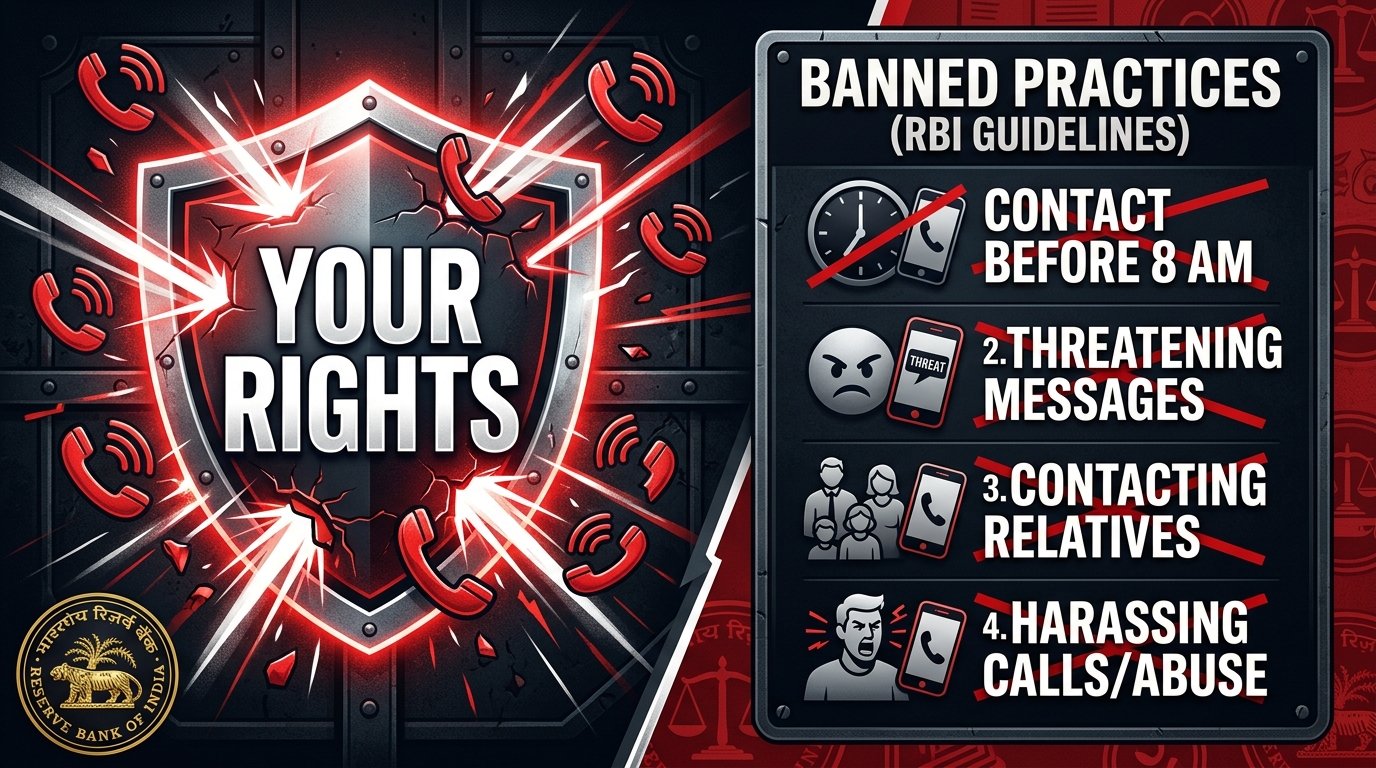
Your phone rings at 11 PM. An aggressive voice says they are calling about your personal loan overdue. They threaten to call your boss, your relatives, your neighbors.
This scenario — unfortunately common across India — is 100% illegal under RBI guidelines, and as of July 2026, the penalties for lenders who allow it have become significantly steeper.
Effective July 1, 2026, the RBI has implemented its “Reserve Bank of India (Commercial Banks — Responsible Business Conduct) Second Amendment Directions, 2026” — a sweeping update to recovery agent conduct rules that gives borrowers stronger protections and gives regulators sharper enforcement teeth.
This is your complete guide: what recovery agents can do, what they absolutely cannot do, how to document violations, and exactly how to file a complaint that forces action.
Table of Contents
- Who Is a Recovery Agent? (Legal Definition)
- RBI-Permitted Recovery Practices: What Agents CAN Do
- What Recovery Agents Are BANNED from Doing (Complete List)
- Permitted Call Timings: The 8 AM–7 PM Rule
- New July 2026 Rules: Mandatory Authentication & Agent Disclosure
- Penalties for Lenders Who Violate Recovery Rules
- How to Document Recovery Harassment (Step-by-Step)
- How to File a Complaint Against a Recovery Agent
- What Happens After You File a Complaint?
- Special Situations: What If You Genuinely Cannot Pay?
- FAQ: RBI Recovery Agent Rules 2026
1. Who Is a Recovery Agent? (Legal Definition)
A recovery agent is a third-party individual or agency hired by a bank, NBFC, or other regulated lender to collect overdue loan payments from borrowers.
Recovery agents are NOT employees of the lender. They are outsourced contractors. However, under RBI regulations, the lender remains fully legally responsible for all actions taken by their recovery agents — including violations, harassment, and illegal conduct.
This is a critical point: you file complaints against the bank or NBFC, not the agent directly. The lender is liable for their agent’s behavior.
2. What Recovery Agents CAN Legally Do
Recovery agents operating within RBI rules are allowed to:
- Call you between 8:00 AM and 7:00 PM on your registered mobile number.
- Send written demand notices, SMS reminders, and emails regarding overdue amounts.
- Visit your registered address during standard business hours (after prior written notice).
- Inform you of the outstanding amount, due date, applicable late fees, and consequences of continued non-payment.
- Discuss restructuring or repayment options on behalf of the lender.
- For secured loans (auto, home, gold): initiate asset repossession only under a valid court order or in strict compliance with the SARFAESI Act.
3. What Recovery Agents Are BANNED from Doing
This is the section you need to screenshot and save. Under RBI’s Fair Practices Code and the 2026 amendment directions, recovery agents face strict, enforceable bans on the following:
| Prohibited Behavior | RBI Rule Violated |
|---|---|
| Calling before 8 AM or after 7 PM | Fair Practices Code — Contact Hours |
| Calling or contacting your relatives, friends, neighbors, or employer | Privacy Protections — Digital Lending Guidelines 2022 |
| Using abusive, threatening, or intimidating language | Responsible Business Conduct Directions 2026 |
| Posting about your loan default on social media or public platforms | Privacy & Data Protection Norms |
| Making repeated, excessive, or intimidating calls in a single day | Fair Practices Code — Harassment Clause |
| Physically threatening or intimidating you during a home visit | Responsible Conduct Rules + BNS (Criminal Law) |
| Entering your home or office without your permission | Trespass Laws + RBI Recovery Guidelines |
| Seizing assets without a court order (for personal/unsecured loans) | Consumer Protection Act 2019 |
| Misrepresenting themselves as court officials or government officers | IPC Sections on Impersonation |
| Sending unauthorized agents not listed on the lender’s official registry | New July 2026 Amendment: Agent Disclosure Mandate |
4. The 8 AM–7 PM Contact Rule: Strictly Enforced from July 2026
The permitted contact window for all recovery communications is 8:00 AM to 7:00 PM, seven days a week including Sundays.
This applies to:
- Phone calls
- WhatsApp messages (where the lender uses official WhatsApp business accounts)
- SMS reminders
- Physical visits to your address
Any contact outside these hours is a direct violation. Document it immediately by:
- Taking a screenshot of the incoming call log showing the time.
- Saving the SMS with timestamp.
- Recording the call (you are legally permitted to record calls you are a party to in India).
5. New July 2026 Rules: Agent Authentication & Public Disclosure
The July 2026 amendment introduced two powerful new consumer protections:
5a. Mandatory Agent Authentication Before Contact
Before any recovery agent visits your home or office, the lender must send you a formal written notice (via letter, SMS, or email) containing:
- The name of the recovery agency engaged.
- The name of the specific agent who will contact you.
- A reference/case number for your account.
If an agent shows up without this prior notification, you have the right to refuse contact and immediately report it to the lender’s grievance officer.
5b. Public Agent Registry on Lender Websites
From July 1, 2026, every bank and NBFC must publish and maintain a publicly accessible list of their empanelled recovery agencies on their official website.
If someone claiming to be a recovery agent contacts you, you can visit the lender’s official website, check their published agent list, and verify instantly whether this person is authorized to contact you on their behalf.
Any agent not on this published list is unauthorized and should be reported immediately.
6. Penalties for Lenders Who Violate Recovery Rules (2026)
The July 2026 amendment significantly increased penalties for systemic recovery violations:
| Violation Type | Penalty Range |
|---|---|
| Individual recovery harassment complaint | ₹5 Lakh to ₹25 Lakh per complaint |
| Systemic / pattern-based violations | ₹25 Lakh to ₹1 Crore |
| Failure to maintain public agent registry | Regulatory censure + ₹5 Lakh |
| Agent contacting third parties (relatives/colleagues) | Immediate FIR-eligible; lender liable under Consumer Protection Act |
7. How to Document Recovery Harassment (Step-by-Step)
Proper documentation is the key to a successful complaint. Here is exactly what to capture:
- Call logs: Screenshot your phone’s call log showing date, time, and number of missed/received calls from the agent. If they call 15 times in one day, screenshot all 15 records.
- Record the call: In India, you may legally record any phone call that you are a party to. Use your phone’s built-in call recorder or a third-party app. Save recordings to cloud storage immediately.
- Screenshot messages: Save all WhatsApp messages, SMS, and email threats. Capture the sender ID, timestamp, and full message content.
- Witness for home visits: If an agent visits your home, ensure a family member or neighbor is present as a witness. Note the agent’s name, agency, time of visit, and what was said or done.
- Medical documentation: If harassment causes anxiety, panic attacks, or health issues, get a doctor’s certificate. This is crucial for claiming compensation at the Consumer Forum.
- Create a dated log: Maintain a simple Word document or notes file listing every incident chronologically: date, time, type of contact, what was said, and your response.
8. How to File a Complaint Against a Recovery Agent
Step 1: Complaint to the Lender’s Grievance Redressal Officer
Every bank and NBFC is legally required to have a designated Grievance Redressal Officer (GRO). Send a formal written complaint to the GRO via email or registered post with all your documentation attached.
The lender must acknowledge your complaint within 3 working days and resolve it within 30 days under RBI’s complaint resolution framework.
Step 2: Escalate to the RBI Ombudsman (If Not Resolved in 30 Days)
If the lender does not respond within 30 days, or if you are unsatisfied with their resolution, escalate to the RBI Integrated Ombudsman:
- Online: cms.rbi.org.in
- Helpline: 14448
- Email: crpc@rbi.org.in
The Ombudsman complaint is free. The RBI has the authority to direct lenders to compensate you for harassment, mental suffering, and financial losses caused by illegal recovery practices.
Step 3: File a Police FIR (For Threats or Physical Intimidation)
If a recovery agent made physical threats, used violent language, or physically intimidated you, file an FIR immediately at your local police station under the relevant sections of the Bharatiya Nyaya Sanhita (BNS) 2023, which replaced the IPC:
- Section 351 (Criminal Intimidation)
- Section 308 (Extortion)
- Section 74/75 (Criminal Force/Assault)
Step 4: Consumer Forum Complaint (For Compensation)
For monetary compensation — including mental harassment damages — file a complaint at your District Consumer Disputes Redressal Commission. Recovery harassment by an agent of a lender constitutes “deficiency in service” under the Consumer Protection Act 2019.
Several borrowers have received compensation ranging from ₹25,000 to ₹5 Lakhs for documented loan recovery harassment cases in Indian consumer courts.
9. What If You Genuinely Cannot Pay Your EMI?
Ignoring the lender when you genuinely cannot pay makes things worse. Here is what to do instead:
- Contact the lender proactively: Write to the lender’s branch manager or nodal officer explaining your financial hardship. Request an EMI moratorium, loan restructuring, or extended tenure.
- Request a “hardship waiver”: Many banks have internal hardship policies that are never publicly advertised. A written request citing job loss, medical emergency, or income disruption can trigger this.
- Seek debt counselling: The RBI has established free Credit Counselling Centers (CCCs) across India. Find your nearest center at rbi.org.in.
- Consider legal debt resolution platforms: Platforms like Freed.care offer professional debt negotiation services for borrowers in financial distress at regulated, transparent fees.
10. FAQ: RBI Recovery Agent Rules 2026
Can a recovery agent call me on Sunday?
Yes — but only between 8 AM and 7 PM. The RBI contact timing rules apply every day of the week, including Sundays and public holidays. However, calling outside the 8 AM–7 PM window on any day is a violation.
Can a recovery agent come to my home?
Yes, but only during business hours and only after the lender has sent you a prior written notice identifying the agent. If they show up without prior notice or outside business hours, you can refuse entry and file a complaint.
My recovery agent messaged my mother about my loan. Is this illegal?
Yes, absolutely. Contacting any third party — including your spouse, parents, siblings, or colleagues — about your loan default is a direct violation of RBI’s Privacy and Fair Practices Code. Document the message and file an immediate complaint with the lender’s GRO and the RBI Ombudsman.
What if the recovery agent threatens to file a police case against me?
A recovery agent has NO authority to file a police case on behalf of the lender for a civil loan default. Only a court can initiate civil proceedings. Threatening criminal action for a loan default (not fraud) is itself an illegal threat. Document it and file a complaint.
Can I ignore calls from recovery agents?
You can choose not to answer. However, completely ignoring the lender makes legal escalation more likely. A better approach is to communicate in writing (email), acknowledge the overdue amount, and formally request restructuring. This creates a paper trail showing good faith.
Will complaining to the RBI Ombudsman affect my CIBIL score?
No. Filing a complaint with the RBI Ombudsman does not affect your credit score in any way. Your CIBIL score is only affected by your repayment behavior — not by regulatory complaints against lenders.
A recovery agent said he will seize my phone/bike. Can he?
For unsecured personal loans: absolutely not. Recovery agents have no legal authority to seize any asset for an unsecured loan without a court order. For secured loans (car loan, gold loan, home loan), seizure must follow strict legal procedures under the SARFAESI Act and requires prior formal notice. Any unauthorized seizure is theft under Indian law.
Conclusion: Know Your Rights — Use Them
India’s borrower protection framework is far stronger in 2026 than most people realize. The RBI’s July 2026 amendment significantly raised penalties, mandated agent authentication, and required public agent registries — giving you more tools than ever to fight illegal recovery harassment.
The three most important things to remember:
- Recovery agents can only contact you between 8 AM and 7 PM. Anything outside this window is illegal.
- Any contact with your family, friends, or colleagues about your loan is strictly prohibited.
- The lender — not the agent — is legally liable for every violation. Complain to the bank, then the RBI Ombudsman, then the Consumer Forum if needed.
Document everything. Report immediately. You have the law on your side.

Sarthak Gupta writes about personal finance, loans and credit for Indian borrowers. His guides on Techy Loan explain CIBIL scores, RBI rules and loan apps in simple language so readers can borrow safely and confidently.









1 thought on “RBI Recovery Agent Rules 2026: Your Complete Legal Rights as a Borrower”