You need ₹1.5 Lakhs for a new laptop, a home renovation, or a medical emergency. You have two options staring at you: take a personal loan, or convert the expense to a 12-month credit card EMI.
Both look similar on the surface. Both give you the item now and let you pay in monthly instalments. But the total cost, the flexibility, the impact on your credit score, and the fine-print traps are dramatically different.
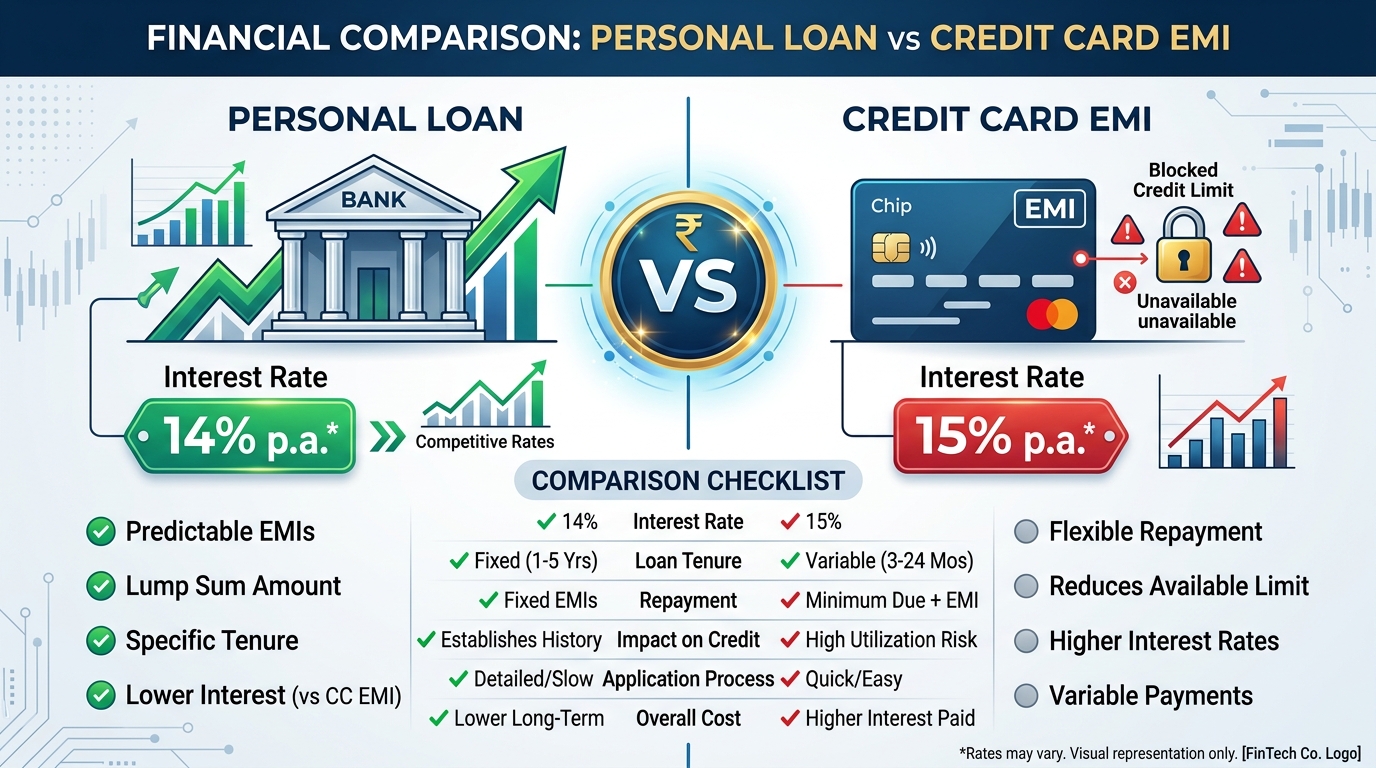
This is the complete 2026 guide to choosing between a personal loan and credit card EMI — with real interest rate calculations, a side-by-side comparison on every dimension that matters, and a final verdict on which to pick for different situations.
Table of Contents
- Quick Answer: Personal Loan vs Credit Card EMI at a Glance
- Interest Rate Deep Dive: Which Is Truly Cheaper?
- Processing Fees, Hidden Charges, and Total Cost of Borrowing
- Real Money Example: ₹1.5 Lakh for 12 Months
- CIBIL Score Impact: Which Hurts Less?
- Flexibility: Prepayment, Foreclosure, and EMI Changes
- Credit Limit Impact: A Hidden Disadvantage of Credit Card EMI
- Who Should Choose a Personal Loan?
- Who Should Choose Credit Card EMI?
- The No-Cost EMI Trap: What Banks Don’t Tell You
- FAQ: Personal Loan vs Credit Card EMI India 2026
1. Quick Answer: Personal Loan vs Credit Card EMI at a Glance
| Feature | Personal Loan | Credit Card EMI |
|---|---|---|
| Interest Rate Range | 10–36% p.a. | 13–42% p.a. (on outstanding balance) |
| Processing Fee | 0.5–3% of loan amount | ₹499–₹999 flat (most banks) |
| Approval Time | Minutes to 24 hours | Instant (no new approval needed) |
| CIBIL Score Needed | 700+ preferred | No new check (uses existing card) |
| Credit Limit Impact | None (separate product) | Blocks your credit limit until repaid |
| Foreclosure Penalty | 2–5% of outstanding (varies) | 3–5% at most banks |
| Maximum Loan Tenure | Up to 60 months (5 years) | 3–24 months typically |
| Best For | Large amounts, longer tenure | Small amounts, convenience |
2. Interest Rate Deep Dive: Which Is Truly Cheaper?
On paper, credit card EMI rates (13–18% p.a. at top banks) look similar to personal loan rates (10–18% p.a. at the same banks). But the comparison is not that simple.
Personal Loan Interest Calculation
Personal loans use a reducing balance method. You pay interest only on the outstanding principal, which decreases with each EMI payment.
A ₹1.5 Lakh personal loan at 14% p.a. for 12 months: your actual total interest paid ≈ ₹11,500 over the full year.
Credit Card EMI Interest Calculation
Most credit card EMI schemes also use reducing balance, but at bank-specific rates. However, the real rate often exceeds the advertised rate when you factor in:
- Processing fee (₹499–₹999 flat, which inflates the effective rate on small amounts)
- GST on interest payments
- Blocked credit limit reducing available credit (opportunity cost)
3. Real Money Example: ₹1.5 Lakh for 12 Months
| Cost Component | Personal Loan @14% p.a. | Credit Card EMI @15% p.a. |
|---|---|---|
| Principal | ₹1,50,000 | ₹1,50,000 |
| Monthly EMI | ₹13,500 | ₹13,550 |
| Total Interest Paid | ~₹12,000 | ~₹12,600 |
| Processing Fee | ₹1,500–₹4,500 (1–3%) | ₹499–₹999 flat |
| Total Cost of Borrowing | ₹13,500 – ₹16,500 | ₹13,100 – ₹13,600 |
| Winner | For amounts above ₹3 Lakh | For ₹1.5 Lakh at short tenure |
4. CIBIL Score Impact: Which Hurts Less?
Personal Loan and CIBIL
- A new personal loan application triggers a hard enquiry that temporarily drops your score by 5–10 points.
- The loan itself appears as a new “installment loan” on your credit profile — which diversifies your credit mix (positive long-term).
- Timely repayment builds your payment history significantly over the loan tenure.
Credit Card EMI and CIBIL
- No new hard enquiry — the EMI conversion uses your existing credit card, so your score is not impacted by a new application.
- However, your credit utilization ratio increases immediately. If you have a ₹3 Lakh limit and convert ₹1.5 Lakh to EMI, your utilization goes from 0% to 50% — which can drop your score by 20–40 points.
- As you repay the EMI, the blocked amount gradually frees up and your utilization improves.
Verdict on CIBIL: For borrowers with credit card limits that are 3x or more the EMI amount, credit card EMI causes minimal CIBIL impact. For borrowers with tight credit limits, a personal loan is better for your credit score.
5. The No-Cost EMI Trap: What Banks Don’t Tell You
Many banks and fintech platforms advertise “No-Cost EMI” on credit card purchases — particularly for electronics, appliances, and e-commerce purchases.
Here is the truth: true no-cost EMI means zero interest. But in most cases:
- The merchant gives the bank a subvention (rebate) equal to the interest cost — effectively pricing the discount into the product’s original price.
- A processing fee of ₹199–₹499 is often charged even on “no-cost” schemes — not zero cost after all.
- If you cancel or prepay a no-cost EMI, the merchant’s subvention is often clawed back — meaning you end up paying interest retroactively.
- Some platforms inflate product prices by 3–5% for customers choosing no-cost EMI versus paying full price upfront.
6. Who Should Choose a Personal Loan?
A personal loan is the better choice when:
- ✅ You need more than ₹2–3 Lakhs
- ✅ You want a longer repayment tenure (24–60 months) with lower EMIs
- ✅ Your credit card limit is tight (utilization would cross 30%)
- ✅ You want to preserve your full credit card limit for emergencies
- ✅ You are consolidating multiple debts into one manageable EMI
- ✅ The purpose is not merchant-linked (medical bill, travel, cash need)
7. Who Should Choose Credit Card EMI?
Credit card EMI wins when:
- ✅ The purchase amount is under ₹1.5–₹2 Lakhs
- ✅ You want instant conversion at checkout with no new loan application
- ✅ Your credit card limit is 3x+ the purchase amount (low utilization impact)
- ✅ The EMI tenure is 6–12 months (short enough that total interest savings are minimal)
- ✅ You have a pre-approved zero-processing-fee EMI offer from your bank
- ✅ Speed is critical and you cannot wait for a personal loan disbursement
Conclusion: The Right Choice Depends on Amount and Tenure
There is no universal winner between personal loan and credit card EMI — the better option depends on three things: the loan amount, the tenure, and your current credit card utilization.
Simple rule of thumb for 2026:
- Amount under ₹1.5 Lakh + tenure under 12 months + credit card limit is 3x the amount → Credit Card EMI
- Amount above ₹2 Lakh OR tenure above 18 months OR tight credit card limit → Personal Loan
Always calculate the total cost of borrowing (principal + interest + all fees) for both options before deciding. A ₹500 processing fee difference can be worth it when the interest savings are ₹5,000 over a 24-month tenure.
Is personal loan interest lower than credit card EMI interest?
For the same credit profile, personal loan rates are typically 2–5% per annum lower than credit card EMI rates from the same bank. However, personal loans have higher processing fees, which can offset the savings on smaller loan amounts under ₹1.5 Lakhs.
Does converting a purchase to credit card EMI affect my CIBIL score?
It does not trigger a hard enquiry, but it temporarily increases your credit utilization ratio — which can drop your CIBIL score by 15–40 points if you have limited credit card limits. The score recovers as you repay the EMI.
Can I foreclose my credit card EMI early?
Yes, but most banks charge a foreclosure penalty of 3–5% on the outstanding EMI amount. Call your bank’s customer care before prepaying to calculate the exact penalty and check if it makes financial sense.
Is no-cost EMI really free?
Usually not entirely. While the stated interest may be 0%, merchants often build the EMI discount cost into the product’s pricing, and banks typically charge a processing fee of ₹199–₹499 even on no-cost EMI schemes. Always read the fine print.
Which is better for my credit score — personal loan or credit card EMI?
Long term, a personal loan that is repaid on time is better for your credit score — it builds installment loan repayment history and diversifies your credit mix. Short term, credit card EMI may cause a temporary score dip due to high utilization if your card limit is tight.
Related guides
- Techy Loan EMI Calculator
- Personal Loan for Freelancers Without ITR in India 2026: Complete Step-by-Step Guide

Sarthak Gupta writes about personal finance, loans and credit for Indian borrowers. His guides on Techy Loan explain CIBIL scores, RBI rules and loan apps in simple language so readers can borrow safely and confidently.








1 thought on “Personal Loan vs Credit Card EMI: Which Is Cheaper in 2026?”