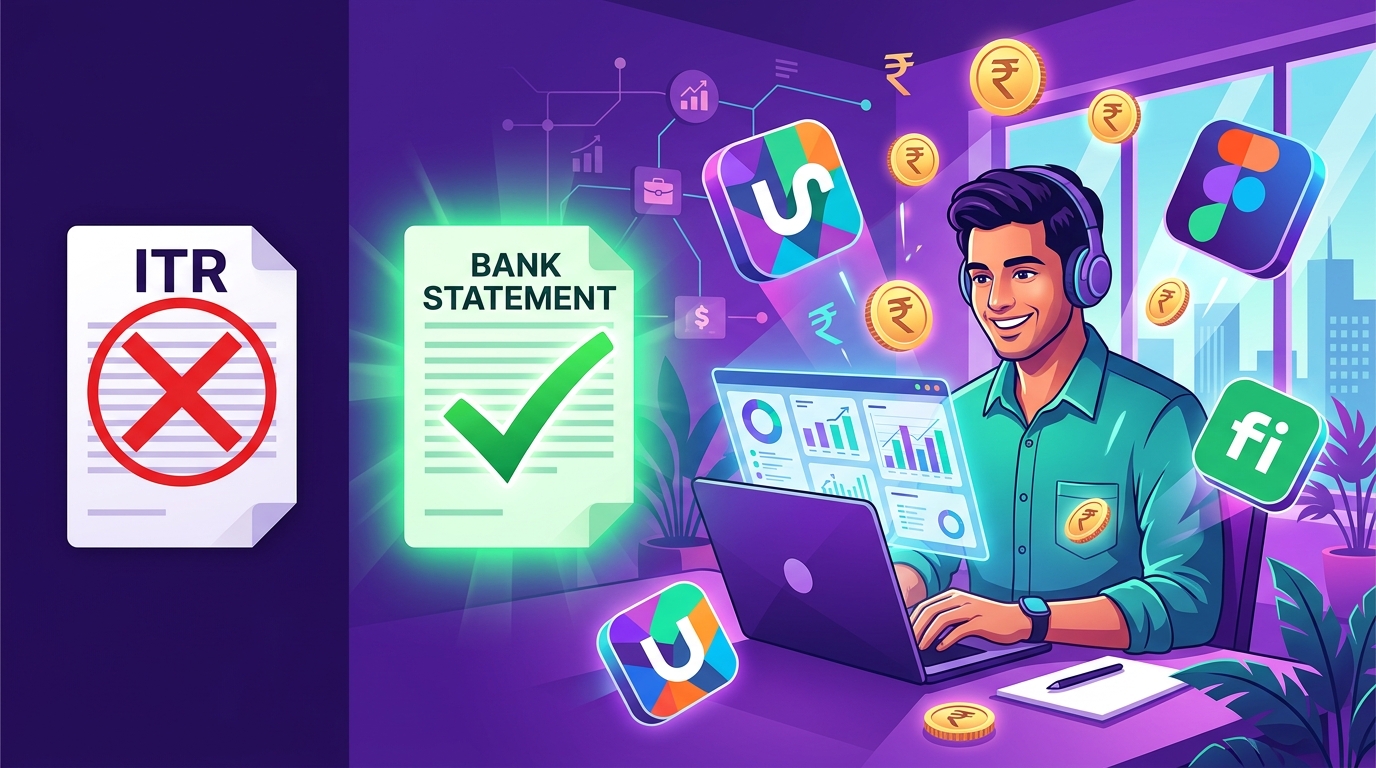
You just landed three new freelance clients this month. Your bank account shows a healthy ₹80,000 in income from client transfers. But your ITR? Either not filed, filed under a very low income slab, or simply not reflecting the current year’s earnings yet.
Sound familiar? This is the reality for over 15 million freelancers and gig workers in India in 2026 — people with genuine, verifiable income who still get rejected by traditional banks the moment they say “I’m self-employed, I don’t have salary slips.”
The good news: the loan market has changed dramatically. Thanks to Account Aggregator-based bank statement analysis, AI-driven underwriting, and RBI’s push for financial inclusion, getting a personal loan without ITR as a freelancer in 2026 is not just possible — it’s increasingly straightforward if you go to the right lenders.
This comprehensive guide covers everything: which lenders approve freelancers, what alternative documents work in place of ITR, how to prepare your financial profile, and how to get the best possible interest rate.
Table of Contents
- Why Banks Reject Freelancers (And Why That’s Changing)
- What Lenders Look For Instead of ITR
- Alternative Documents That Replace ITR for Loan Approval
- Best NBFCs and Apps That Approve Freelancers Without ITR (2026)
- Interest Rate Comparison: Freelancer vs. Salaried Applicant
- Step-by-Step: How to Apply for a Freelancer Personal Loan
- How to Maximize Your Approval Chances
- Loan Against Fixed Deposit / Gold: Easiest Option for Freelancers
- Common Mistakes Freelancers Make During Loan Applications
- FAQ: Personal Loans for Freelancers Without ITR
1. Why Banks Reject Freelancers (And Why That’s Changing)
Traditional banks designed their personal loan products for salaried employees — a 30-year-old formula built around salary slips, Form 16, and ITR showing stable annual income.
For freelancers, this model breaks down because:
- Income is irregular — large payments in some months, smaller amounts in others.
- Clients often pay via UPI, bank transfers, or international platforms (PayPal, Wise) — making income patterns harder to verify with traditional paperwork.
- Many freelancers file ITR under lower income slabs to reduce tax liability — which paradoxically hurts their loan eligibility.
- No employer to call for verification, no HR department, no appointment letter.
However, since 2023, a major shift has been underway. The Account Aggregator (AA) framework, combined with AI-based credit underwriting, allows lenders to analyze your actual bank account cash flows — regardless of whether you have an ITR.
In 2026, several leading NBFCs now make credit decisions based primarily on 6 to 12 months of bank statement data, turning your actual client payment history into your proof of income.
2. What Lenders Look For Instead of ITR
When you apply as a freelancer without ITR, here is what the lender’s AI underwriting system actually evaluates:
| Factor Evaluated | Why It Matters | Ideal Signal |
|---|---|---|
| Monthly bank credits | Shows actual earning capacity | ₹20,000+ in credits/month consistently |
| Credit-to-debit ratio | Shows if income exceeds spending | Credits > 70% of debits |
| Account balance trajectory | Is savings growing or depleting? | Consistent or growing average balance |
| Number of income sources | Diversification = lower risk | Multiple client transfers |
| CIBIL score | Historical repayment behavior | 700+ preferred; 650+ acceptable at NBFCs |
| GST registration / Udyam certificate | Formal business verification | Active GST/Udyam registration |
| Existing EMI obligations | Debt-to-income ratio | Total EMIs < 40% of monthly income |
3. Alternative Documents That Replace ITR for Freelancers
You may not need ITR at all if you can provide the following combination of alternative documents:
Essential Documents (Required by Almost All Lenders)
- ✅ Aadhaar Card (for Video KYC identity verification)
- ✅ PAN Card (mandatory for all loans above ₹50,000)
- ✅ Bank Statements — Last 6 to 12 Months (the single most important document for freelancers)
- ✅ Selfie / Liveness Photo (for digital KYC)
Supporting Documents That Strengthen Your Application
- 📄 Client Invoices / Contracts — 3 to 5 recent invoices showing your freelance work, client name, amount, and payment terms.
- 📄 Freelance Platform Payment Proof — Upwork, Fiverr, Toptal, or Freelancer.com payout statements or transaction history.
- 📄 GST Registration Certificate — If your annual turnover exceeds ₹20 Lakhs, you are likely GST-registered. This adds significant credibility.
- 📄 Udyam/MSME Registration — Register your freelance practice as an MSME at udyamregistration.gov.in (free, instant). This certificate is a powerful document for NBFCs.
- 📄 Professional Profile Proof — LinkedIn profile showing client history, portfolio website, or professional domain email (yourname@yourbusiness.com).
4. Best NBFCs and Apps Approving Freelancers Without ITR (2026)
| Lender | Loan Amount | Interest Rate | ITR Required? | Bank Stmt Months |
|---|---|---|---|---|
| KreditBee | ₹1,000 – ₹4 Lakh | 16–29.95% p.a. | ❌ Not Required | 3–6 months |
| Moneyview | ₹5,000 – ₹10 Lakh | 16–39% p.a. | ❌ Not Required | 3–6 months |
| Fibe (EarlySalary) | ₹5,000 – ₹5 Lakh | From 14% p.a. | ❌ Not Required | 3 months |
| Faircent (P2P) | ₹30,000 – ₹10 Lakh | 12–28% p.a. | ⚠️ Optional | 6–12 months |
| DMI Finance | ₹1 Lakh – ₹25 Lakh | From 12% p.a. | ⚠️ Optional (GST preferred) | 6 months |
| IDFC FIRST Bank | ₹1 Lakh – ₹40 Lakh | From 10.49% p.a. | ⚠️ 1–2 years ITR preferred | 12 months |
| LoanTap | ₹50,000 – ₹10 Lakh | From 18% p.a. | ❌ Not Required | 6 months |
5. Step-by-Step: How to Apply for a Freelancer Personal Loan in 2026
Step 1: Check and Clean Your CIBIL Score (Week 1)
Pull your free CIBIL report at cibil.com. Check for errors, ghost loans, or missed payment marks. Your score should ideally be 700+. If it is 650–699, you can still apply at NBFCs but expect a higher interest rate.
Step 2: Organize Your Bank Statements (Week 1–2)
Download PDF bank statements for the last 6 to 12 months from your primary bank account. Ensure this account receives the majority of your client payments. Banks offering Account Aggregator-based sharing will pull this automatically, but having PDFs ready speeds up applications at other lenders.
Important: If your income is split across multiple bank accounts, consolidate your primary client payments into one account at least 3 months before applying.
Step 3: Register as an MSME/Udyam (Week 1)
Visit udyamregistration.gov.in and register your freelance work as a micro-enterprise. It is free, takes 10–15 minutes, and requires only Aadhaar and PAN. The Udyam certificate you receive is a powerful income-verification document for NBFCs.
Step 4: Gather Supporting Income Proof (Week 2)
Collect 3 to 5 recent client invoices, your freelance platform payout statements (if applicable), or any ongoing client contracts. Create a simple “Income Summary” document listing your last 6 months of income with client names and amounts.
Step 5: Compare Lenders and Check Pre-Approved Offers (Week 2–3)
Use loan aggregator apps like Paisabazaar, BankBazaar, or Bajaj Markets to check pre-approved loan offers across multiple lenders simultaneously. These soft-check platforms do not hurt your CIBIL score and instantly show you which lenders are likely to approve you at what rate.
Step 6: Apply to the Best-Matched Lender (Week 3)
Apply formally to the lender with the best rate that matched your profile. Use Account Aggregator consent for bank statement sharing if offered — it speeds up approval from days to minutes.
Step 7: Complete Video KYC (Week 3)
Most digital lenders conduct a short Video KYC session (5–10 minutes) where you show your Aadhaar card to the camera and answer basic identity questions. Ensure good lighting and a stable internet connection.
6. How to Maximize Approval Chances as a Freelancer
- 🎯 Route all client payments to one account: A single bank account with consistent, high-value inflows looks far stronger than fragmented income across 3 accounts.
- 🎯 Maintain a 3-month minimum balance: Keep at least ₹10,000–₹15,000 as your average minimum balance for 3 months before applying. Low or zero balances signal financial stress.
- 🎯 Clear any existing EMIs: If you have an active personal loan or credit card with high utilization, pay it down before applying. Each loan you carry reduces your new loan eligibility.
- 🎯 Apply for 30–40% less than your maximum eligibility: Asking for ₹2 Lakhs when you qualify for ₹3 Lakhs increases approval probability significantly.
- 🎯 Add a co-applicant if your profile is borderline: A spouse or parent with a stable salary and good credit score acting as co-applicant dramatically improves approval chances and may lower your interest rate.
7. Easiest Option: Loan Against FD or Gold
If your freelancer personal loan application is getting rejected repeatedly, consider these fully secured alternatives:
Loan Against Fixed Deposit (LAD/FD Overdraft)
If you have an FD (Fixed Deposit) with any bank, you can get an overdraft facility of 90–95% of the FD value at an interest rate just 1–2% above your FD rate.
Example: ₹2 Lakh FD → ₹1.8–1.9 Lakh loan at 7–9% p.a. No ITR needed. No credit score check. Approval in minutes.
Gold Loan
Gold loans are the fastest, cheapest secured loan for freelancers. With physical gold as collateral, lenders like Muthoot Finance, Manappuram, and IIFL offer:
- ₹1,500 per gram of gold (up to 75% of gold value)
- Interest rates: 8–15% p.a.
- Approval in 30 minutes
- No ITR, no CIBIL check, no salary proof needed
8. FAQ: Personal Loan for Freelancers Without ITR (2026)
Can I get a personal loan as a freelancer with no ITR filed?
Yes. Several NBFCs and fintech lenders (KreditBee, Moneyview, Fibe, LoanTap) approve personal loans for freelancers based entirely on bank statement analysis without requiring ITR. Your 6-month bank statement showing consistent income is the primary evaluation document.
What is the minimum monthly income required for a freelancer personal loan?
Most fintech NBFCs require a minimum monthly income of ₹15,000–₹25,000 reflected consistently in bank credits. Some smaller-ticket lenders (mPokket, KreditBee mini loans) approve from ₹10,000 monthly income for loans up to ₹50,000.
Will my variable monthly income hurt my loan application?
Not necessarily. Lenders evaluate your average monthly income over 6 to 12 months, not your income in any single month. A freelancer earning ₹40,000 in good months and ₹15,000 in slow months (average: ₹27,500) will still qualify for a reasonable loan amount based on the average.
Can international freelance income (from clients abroad) count toward loan eligibility?
Yes — if it appears in your Indian bank account as a wire transfer, SWIFT credit, or platform payout (Payoneer, Wise, etc.). Lenders evaluate INR credits in your Indian bank account regardless of their source. International income converted and received in your account counts fully.
Is CIBIL score important for a freelancer personal loan without ITR?
Absolutely. Since you don’t have traditional income proof (ITR, salary slips), your CIBIL score becomes even more important — it serves as the primary indicator of your creditworthiness. A score of 700+ significantly improves approval chances and lowers interest rates. Below 600 makes approval very difficult at reputable lenders.
What loan amount can I get as a freelancer without ITR?
Typically 5 to 10 times your average net monthly income. If your bank account shows consistent ₹30,000 per month in credits, you may qualify for ₹1.5 to ₹3 Lakhs at fintech NBFCs. Larger amounts (₹5 Lakhs+) generally require ITR or GST returns even at flexible lenders.
Can I get a home loan as a freelancer?
Yes, but home loans are significantly harder without ITR. Most housing finance companies require at least 2–3 years of consistently filed ITR showing growing income. However, IIFL Home Finance and Aadhar Housing Finance specialize in self-employed and informal income borrowers, and some accept 12+ months bank statements in lieu of ITR for smaller ticket home loans.
Conclusion: Your Freelance Income IS Loanable — With the Right Approach
In 2026, the Indian lending market has genuinely evolved to accommodate freelancers and gig workers — something that was nearly impossible just 5 years ago.
The key is preparation: channel your income through one bank account, maintain it consistently for 6+ months, register as an MSME for free, and approach the right NBFCs (KreditBee, Moneyview, Fibe, LoanTap) rather than traditional banks that still rely on outdated ITR-first models.
Your irregular income is not a disqualifier — it just needs to be presented correctly. Follow the steps in this guide, and you’ll have a strong personal loan application ready in under 3 weeks.

Sarthak Gupta writes about personal finance, loans and credit for Indian borrowers. His guides on Techy Loan explain CIBIL scores, RBI rules and loan apps in simple language so readers can borrow safely and confidently.











1 thought on “Personal Loan for Freelancers Without ITR in India 2026: Complete Step-by-Step Guide”