On July 1, 2026, the Reserve Bank of India quietly changed a rule that affects every single loan borrower in India.
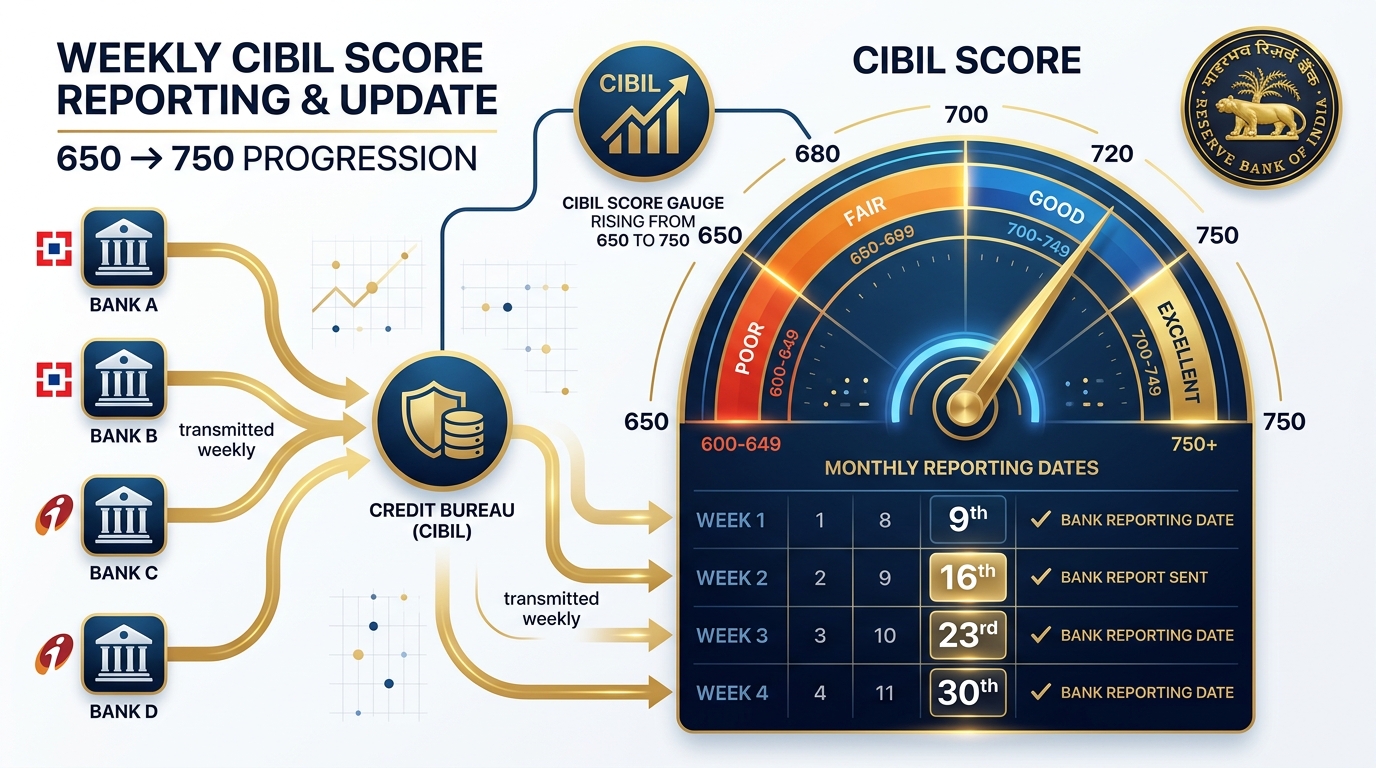
Banks and NBFCs are now legally required to report your credit information to bureaus like CIBIL, Experian, CRIF, and Equifax four times every month — on the 9th, 16th, 23rd, and the last day of each month.
Previously, most lenders reported only once a month. Some smaller NBFCs reported even less frequently — every 45 to 60 days.
This change — the RBI’s new weekly credit reporting mandate — is one of the most significant shifts in India’s credit ecosystem in a decade. It directly affects how quickly your CIBIL score changes, how fast loan approvals respond to your credit behavior, and how soon errors in your report can be corrected.
If you have an active loan, a credit card, or plan to apply for one soon, this guide is essential reading.
Table of Contents
- What is the RBI Weekly CIBIL Reporting Mandate?
- The Old System vs. The New System: Key Differences
- What Are the 4 Reporting Dates Every Month?
- How Will This Change Affect YOUR Credit Score?
- How Does Weekly Reporting Help When You Repay a Loan?
- How Does It Hurt You When You Miss a Payment?
- How to Use Weekly Reporting Strategically Before a Loan Application
- How Weekly Reporting Speeds Up Error Correction and Disputes
- What You Should Do Right Now
- FAQ: RBI Weekly CIBIL Reporting Explained
1. What is the RBI Weekly CIBIL Reporting Mandate?
The RBI’s new mandate, issued under the Credit Information Companies (Regulation) Act, 2005 and its 2026 amendment directions, requires all regulated entities — including commercial banks, small finance banks, NBFCs, and housing finance companies — to submit credit data to credit information companies (CICs) on a weekly cycle.
The official directive was published by the RBI in early 2026 with an effective date of July 1, 2026.
The goal behind this change, as stated by the RBI, is to:
- Improve credit market accuracy by ensuring lenders see the most current repayment data when making credit decisions.
- Reduce information asymmetry between lenders and borrowers.
- Accelerate dispute resolution by making credit report corrections faster.
- Support RBI’s broader financial inclusion goals by giving “new-to-credit” borrowers faster credit trail recognition.
In simple terms: your financial behavior is now visible to potential lenders far more quickly than it was before July 2026.
2. The Old System vs. The New System
| Feature | Old System (Before July 2026) | New System (From July 2026) |
|---|---|---|
| Reporting Frequency | Monthly (once a month) | Weekly (4 times a month) |
| Data Lag | Up to 45–60 days | 7–10 days maximum |
| Loan Closure Update | 30–45 days after closure | Within 7–10 days |
| EMI Miss Reflected | Next month’s report cycle | Within 7 days of the reference date |
| Dispute Resolution Speed | 45–60 days after lender approval | 7–14 days after lender approval |
| Pre-Loan Score Optimization Window | Wait 1–2 months | Act 7–10 days before application |
3. What Are the 4 Reporting Dates Every Month?
Under the new framework, lenders must submit incremental credit data (changes since the last submission) on the following reference dates each month:
- 📅 9th of the month
- 📅 16th of the month
- 📅 23rd of the month
- 📅 Last day of the month
Additionally, lenders must submit a full-file data update — covering all active accounts — by the 5th of the following month.
This means your CIBIL report is now updated approximately every 7 days, instead of every 30–45 days previously.
4. How Will This Change Affect YOUR Credit Score?
The methodology for calculating your CIBIL score has NOT changed. The same 5 factors still drive your score:
- Payment history (35%)
- Credit utilization (30%)
- Length of credit history (15%)
- Credit mix (10%)
- New credit enquiries (10%)
What has changed is the freshness of the data feeding into that calculation. Your score will now reflect your most recent behavior much more quickly.
Scenario A: You Pay All Your EMIs on Time
Under the old system, your timely payment on July 1st might not reflect in your CIBIL report until late July or even early August.
Under the new system, your July 1st payment shows up by July 9th or 16th — already visible to any lender who checks your report in mid-July.
Impact: Positive. Your good behavior is rewarded much faster.
Scenario B: You Miss an EMI
If you miss your July 5th EMI payment, this overdue status will be reported to CIBIL as early as July 9th — within just 4 days.
Previously, you might have had 25–35 days before this showed on your credit report, giving you time to quietly catch up.
Impact: Negative for late payers. There is now almost no “grace window” for credit bureau visibility of missed payments.
Scenario C: You Close a Loan
One of the biggest benefits of weekly reporting: if you close a personal loan on July 10th, CIBIL will reflect the “Closed” status by July 16th — in about 6 days.
Previously, a loan closed on July 10th might still show as “Active” on CIBIL until mid-August — potentially blocking a new loan application you need in late July.
Impact: Strongly positive for borrowers who recently closed loans.
5. How to Use Weekly Reporting Strategically Before a Loan Application
The new weekly reporting cycle creates a powerful planning window for anyone about to apply for a home loan, car loan, or personal loan.
Here is a 30-day pre-loan application strategy:
- Day 1–5: Check your current CIBIL report at cibil.com. Identify any open loans, high credit card utilization, or errors.
- Day 6–10: Pay down your credit card balance below 30% of the credit limit. Pay any overdue EMIs. Close any small loan with a final settlement payment if needed.
- Day 11–16: These payments are captured in the next reporting cycle (16th). Your score update begins flowing in.
- Day 17–23: Check your CIBIL report again. Confirm the updated data has been received. Your score should show an improvement reflecting your recent actions.
- Day 24–30: Apply for your new loan. Your credit report now reflects your most recent, improved financial behavior — giving you the best possible chance of approval at a lower interest rate.
6. How Weekly Reporting Speeds Up Error Correction and Disputes
One of the most consumer-friendly impacts of the new weekly reporting cycle is dramatically faster error resolution.
Previously, when you raised a dispute on CIBIL:
- CIBIL forwards the dispute to the lender within 21 days.
- The lender investigates and confirms correction.
- The lender submits the corrected data in the next monthly reporting cycle — which could be 30 more days away.
- Total time from dispute to correction: 45–60+ days.
Under the new system:
- CIBIL forwards the dispute to the lender within 21 days.
- The lender investigates and confirms correction.
- The corrected data now appears in the next weekly reporting cycle — within 7 days of lender confirmation.
- Total time from dispute to correction: 25–30 days — a massive improvement.
This means if you have a ghost loan, a wrongly marked “Overdue” status, or a closed loan still showing as “Active,” resolution is now almost twice as fast as before.
7. What You Should Do Right Now (Action Checklist)
Given the new weekly reporting landscape, here is what every borrower should do in July 2026:
- ✅ Pull your free CIBIL report today at cibil.com — it’s free once every 12 months, or use the free check on apps like Paytm Money, BankBazaar, or Paisabazaar.
- ✅ Check all active and closed accounts for accuracy — look for ghost loans, incorrect EMI status, or loans not marked as closed.
- ✅ Clear any overdue payments immediately — under weekly reporting, overdue status is now visible to lenders within days, not weeks.
- ✅ Keep credit card utilization below 30% — if you’re close to your limit, paying down even ₹5,000–₹10,000 now will reflect in your score within 7 days.
- ✅ Set up EMI auto-debit on every loan — a single missed payment is now far more visible and damaging than it was before.
- ✅ Raise disputes promptly — don’t wait. With weekly cycles, disputes resolve faster than ever before.
Conclusion: Weekly CIBIL Reporting Is a Game-Changer — If You Act Smart
The RBI’s weekly CIBIL reporting mandate, effective July 1, 2026, is genuinely the most significant upgrade to India’s credit information ecosystem in years.
For responsible borrowers who pay on time, this is excellent news — your good habits now build your credit profile faster than ever. For those who are occasionally late or sloppy with EMI payments, the stakes are higher — negative events are visible to lenders almost immediately.
The bottom line is simple: the monthly reporting “forgiveness window” no longer exists.
If you’re planning a major loan application — for a home, car, business, or personal use — the smartest move is to audit your CIBIL report today, fix whatever you can, and allow 2 to 3 weekly reporting cycles (about 21 days) to reflect your improved credit behavior before you apply.
Share this article with anyone who has an active loan or credit card in India — the new weekly CIBIL reporting system affects every one of them, whether they know it or not.
Does weekly CIBIL reporting mean my credit score changes every week?
Not necessarily. While the data feeding into your score is now refreshed weekly, your CIBIL score changes only when there is a material change in your credit data — like a payment, a new loan, a closure, or an overdue event. Minor routine activity won’t cause weekly score swings.
Do all banks follow the new weekly reporting rule from July 1, 2026?
Yes. The RBI mandate applies to all regulated entities (banks, NBFCs, small finance banks, housing finance companies). Non-compliance can attract significant regulatory penalties from the RBI.
Will my CIBIL score be updated 4 times a month now?
Your credit data at CIBIL will be refreshed up to 4 times per month as lenders submit updates. However, CIBIL calculates and makes your score available based on all submitted data at any given time — it is not a fixed 4-times-per-month score calculation cycle.
Can I check my CIBIL score for free every week?
Yes. TransUnion CIBIL offers one free credit report per year officially. However, many apps (Paytm, BankBazaar, OneScore, Paisabazaar) offer unlimited free CIBIL soft-checks that do not impact your score. You can monitor your score as frequently as you want using these platforms.
I just closed a personal loan. How long before CIBIL shows it as “Closed”?
Under the new weekly reporting system (from July 2026), your lender will report the closure at the next weekly reference date (9th, 16th, 23rd, or last day of month). You should see the “Closed” status on CIBIL within 7 to 14 days of your loan closure, depending on when in the cycle the closure happened.
Will weekly reporting help my CIBIL score recover faster after a missed payment?
Yes — but only after you repay the overdue amount. Once you clear the dues, the updated “Current” status is reported to CIBIL within 7 days in the next weekly cycle. Under the old monthly system, this update could take 30–45 days. So recovery is much faster now.
I just got an ITR-based loan approval. Does weekly reporting affect my new loan account visibility?
Yes. Your new loan account will now appear on your CIBIL report within 7–10 days of disbursal — compared to up to 45 days previously. This is important because multiple new loans appearing simultaneously can temporarily reduce your score due to a spike in “new credit” enquiries and accounts.
What happens if a lender misses the weekly reporting deadline?
The RBI has mandated strict penalties for lenders who fail to comply with the weekly reporting schedule. Borrowers who discover that a lender has not updated their information on time can file a complaint with the RBI Ombudsman at cms.rbi.org.in.
Related guides
- How to Increase CIBIL Score from 600 to 750 in 6 Months (2026)
- Ghost Loan in CIBIL Report: How to Dispute & Get ₹100/Day Compensation (2026)
- How to Clear Settled or Active Status in CIBIL Report Online
- Techy Loan EMI Calculator

Sarthak Gupta writes about personal finance, loans and credit for Indian borrowers. His guides on Techy Loan explain CIBIL scores, RBI rules and loan apps in simple language so readers can borrow safely and confidently.











1 thought on “RBI Weekly CIBIL Reporting Rules (July 2026): What Every Borrower Must Know”